76 Allds St, Nashua, NH 03060
By Nashua Smile Makers | August 14, 2026
You can usually tell where someone parks it.
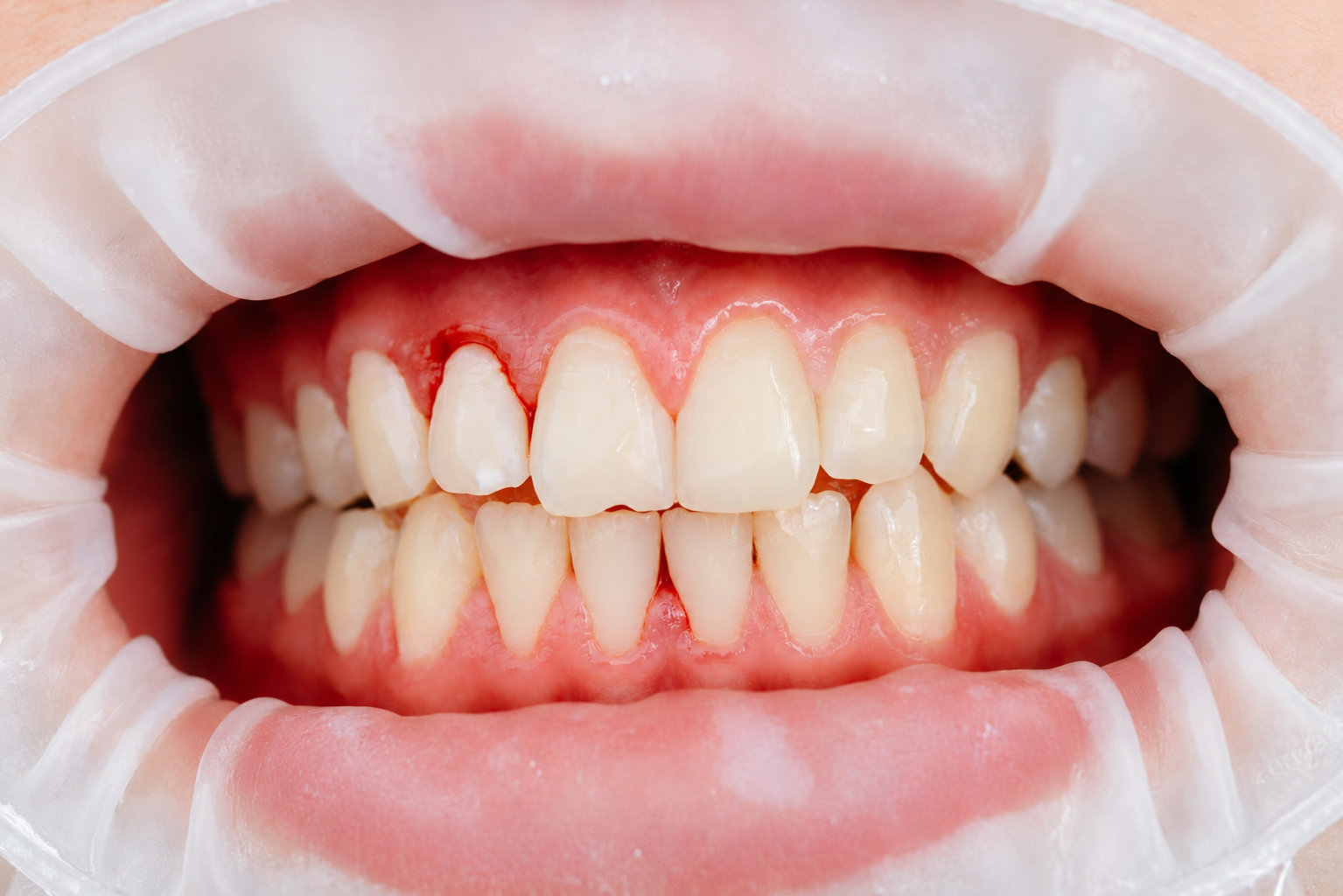
That’s the part that surprises patients most. Damage from nicotine pouches isn’t spread evenly around the mouth as it would be from smoking. It shows up in one spot, at one or two teeth, exactly where the pouch sits night after night.
Which means the gumline ends up recording the habit.
What “Tobacco-Free” Actually Means
The label isn’t lying. ZYN, On!, Velo, and Rogue contain no tobacco leaf, and removing the leaf does remove a real cancer risk that traditional dip and chew carry.
But two things stay behind.
Nicotine. It constricts blood vessels, including the tiny ones feeding your gum tissue. Less blood flow means slower healing and a weaker inflammatory response.
The pouch itself. A small, damp object pressed against soft tissue for fifteen to thirty minutes, several times a day, every day. That’s mechanical pressure and chemical exposure in the same spot, repeatedly.
“Tobacco-free” was never a claim about your gums.
What the Evidence Actually Shows
I’ll give you the honest version, including where it’s thin.
In late 2025, BMC Oral Health published two case reports of young, otherwise healthy men who developed localized gum recession and white patches at the exact sites where they habitually placed pouches. One had used them daily for eleven months in the same spot. Both denied aggressive brushing and grinding, and neither had generalized gum disease. The damage was site-specific.
Broader reviews of smokeless products point in the same direction. A 2026 review found a significant, localized increase in gum recession at the precise sites where snus and pouches are placed, describing the resulting attachment loss as irreversible. Notably, users also showed higher gum inflammation regardless of how much plaque they had, which suggests the product itself is driving it.
A systematic review of nicotine pouch studies found the most common oral side effects were mouth lesions in 48% of participants and sore mouth in 37%. Not a fringe experience.
Now the honest caveat: short-term studies, the three-to-six-month kind, generally haven’t detected measurable recession. That’s not as reassuring as expected. Recession is slow. Six months is nowhere near long enough to catch it, and most pouch users have been at it far longer than the studies ran.
The Difference That Matters Most
Here’s the distinction I want people to walk away with.
Those white patches at the placement site? Research shows they often regress partially or completely once the product stops. Tissue recovers.
Gum recession does not. Once the gum has migrated down and attachment is lost, it does not grow back on its own. Fixing it means a gum graft, which is real surgery with real cost.
The white patch may heal. The gumline won’t.
That asymmetry is the whole reason I bring this up with patients in their twenties rather than waiting.
If You’re Not Ready to Quit
Most people aren’t, and I’d rather give you something useful than a lecture you’ll ignore.
Stop parking it in the same place: Site-specificity is the clearest finding in this entire literature. Rotating placement spreads the exposure instead of concentrating it on two teeth.
Cut the contact time: Average use runs around eleven minutes per pouch in the research. Longer sessions mean longer exposure.
Rinse with water afterward: Simple, free, and helps clear residual nicotine and flavoring from the tissue.
Tell us you use them: This is the big one. If we know, we chart those specific sites and measure recession over time, which means we catch a 1mm change instead of finding 4mm three years later.
Watch for a white patch that doesn’t go away: Lesions that persist after stopping need to be looked at, not monitored indefinitely at home.
And one thing worth knowing if implants are ever in your future: nicotine impairs healing. It affects outcomes for extractions, grafts, and implant integration. Something to weigh now rather than later.
Why We’re Seeing More of This Around Nashua
Two reasons, and neither is complicated.
New Hampshire has no sales tax, and Nashua sits directly on the Massachusetts line with a retail corridor built for cross-border shopping. Nicotine pouches are cheap here and easy to buy.
The other reason is who uses them. The heaviest use skews young and male, and it’s often people who quit vaping or never smoked at all, believing they’d found something with no downside. Discretion is the selling point. No smoke, no spit, nothing to notice.
Which is exactly why the first time anyone flags it tends to be at a cleaning. We see patients from Nashua, Hudson, Merrimack, Litchfield, Hollis, Amherst, Milford, and Pelham, and this has become a routine part of the conversation.
What We Look For
Recession measurements at specific teeth. Root surfaces newly exposed. White or thickened patches along the inside of the lip. Sensitivity in a spot that used to be fine.
None of that requires anything unusual, just knowing where to look. And knowing to look means you are telling us.
Schedule a consultation at our Allds Street office, or meet our dentists first. You can also read more about periodontal disease treatment and general dentistry.
Frequently Asked Questions (FAQ’s)
Can ZYN and nicotine pouches cause gum recession?
Yes, published case reports and reviews show localized gum recession developing at the exact spot where pouches are repeatedly placed.
Does gum recession from nicotine pouches grow back?
No, gum recession is permanent and can only be corrected surgically with a gum graft.
Are nicotine pouches safer than chewing tobacco for your gums?
They remove tobacco leaf and its cancer risk, but nicotine and physical contact still cause localized recession and mucosal lesions.
What are the white patches from nicotine pouches?
They’re mucosal lesions at the placement site, reported in roughly half of users, and they often fade after stopping the product.
How can I use nicotine pouches with less gum damage?
Rotate the placement site rather than using the same spot, limit contact time, rinse with water afterward, and tell your dentist so those areas get measured.